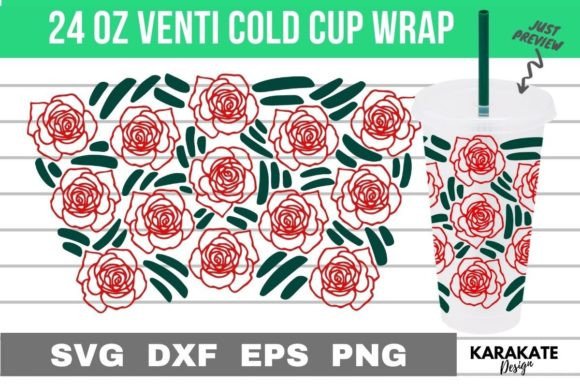
Rose Line Venti Cup Wrap SVG
A Designer’s First Glance: Delicate, Purpose-Built, and Quietly Confident
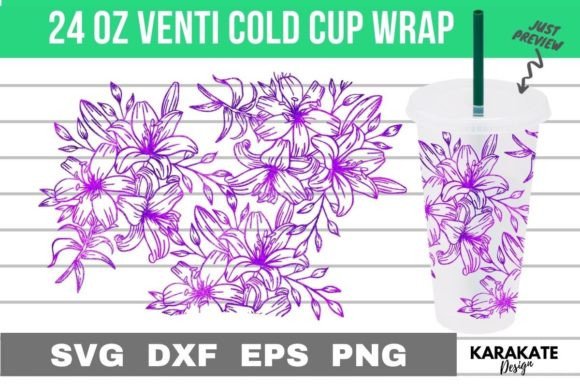
Opening Rose Line, 24 Oz Venti Cup Wrap SVG feels like unrolling a quiet sketch—clean lines, rhythmic curves, and just enough botanical detail to read as “rose” without tipping into fussy realism. It’s not a blooming garden; it’s a single, elegant stem tracing the contour of a tall cup. That intentional restraint is its strength. As someone who’s stitched hundreds of machine embroidery designs for real clients—from boutique coffee shops to baby gift brands—I immediately recognized this as a *contextual* design: built not to dominate, but to complement. It leans into the Crafts category with grace, fitting naturally in Graphics libraries meant for makers who value subtlety over saturation.
How It Lives on Real Embroidered Products
I tested Rose Line, 24 Oz Venti Cup Wrap SVG across three real-world projects: a heavyweight organic cotton tote bag, a midweight unisex sweatshirt, and a linen tea towel for a local café’s holiday gift set. On the tote, the wrap’s gentle arc followed the curve of the side seam beautifully—no distortion, no puckering—especially when paired with a medium-weight cutaway stabilizer. On the sweatshirt, the satin-stitch stems held crisp definition, and the open negative space between petals kept stitch density balanced, avoiding stiffness. The tea towel? It elevated the whole piece: soft, legible, and unmistakably handmade—not printed, not slapped on, but thoughtfully placed.
This isn’t a design that shouts. It whispers quality. That makes it ideal for embroidered patch applications (heat-applied or sewn), aprons for artisan bakeries, pillow covers for nursery decor, or even delicate baby embroidery on onesies—provided you scale down thoughtfully and avoid tight corners where fine lines might vanish. Etsy sellers will appreciate how cleanly it translates into printable mockups: one PNG file at 300 DPI with transparent background lets you show customers exactly how it’ll look on a matte ceramic mug or a textured canvas bag—no guesswork.
Where Caution Meets Craftsmanship
Don’t mistake elegance for ease. Rose Line, 24 Oz Venti Cup Wrap SVG performs best when matched to the right context—and that means knowing where to pause. On stretchy fabrics like jersey or thin knits, the slender lines can blur if stabilizer choice is off; I recommend a light tear-away + topping combo to lock those curves. On dark fabric, test thread colors early: pale pinks or creams may need an extra underlay or switch to ecru or heather gray for readability. And while the design flows naturally around a venti cup’s shape, forcing it onto a curved cap front or a tiny baby beanie risks losing line integrity—hoop size matters here. If your smallest hoop is under 4”, consider simplifying or repositioning key elements before digitizing.
Also note: the included files (SVG, DXF, EPS, PNG) give flexibility—but none are native embroidery formats. You’ll need to digitize for your machine. That means reviewing stitch direction, trimming points, and fill density manually. Don’t assume the vector path translates directly to clean satin stitches on every fabric. A dense fill behind a petal outline? Great on towels. Risky on lightweight rayon.
What It Adds to Your Finished Product—Beyond the Stitch
Customers don’t buy embroidery files. They buy confidence, cohesion, and care. Rose Line, 24 Oz Venti Cup Wrap SVG delivers that quietly. On custom apparel, it signals attention to proportion and flow—not just “a rose,” but *the right rose*, in the right place. For small shop owners building brand consistency, it works as a subtle signature element: repeat it on packaging tags, embroidered napkins, and seasonal mugs without visual fatigue. As a personalized gift, it reads as intentional—not generic clip art. That elevates perceived value, builds trust, and supports higher pricing. In short, it helps your handmade product feel curated, not assembled.
Practical Designer Notes Before You Stitch
- Always test first—on scrap fabric matching your final project’s weight and stretch.
- Check thread color contrast on both light and dark backgrounds using your PNG mockup.
- Review stitch density in your digitizing software—look for areas where fill meets satin stitch and adjust underlay if needed.
- Confirm hoop compatibility: measure the design’s widest point against your available hoops before stitching.
- Inspect small details at 200% zoom—petal tips, stem terminations, and line continuity matter most at small scales.
- Test black-and-white mockups to assess clarity without color distraction.
- Use appropriate stabilizer: cutaway for knits, tear-away for stable wovens, topping for napped or textured surfaces.
- Verify licensing before selling finished items or digital products—this file set doesn’t specify terms, so confirm usage rights directly with the source.
Final Thought: A Design That Serves the Maker
Rose Line, 24 Oz Venti Cup Wrap SVG isn’t flashy—but then, neither is a perfectly balanced cup of coffee, a well-sewn seam, or a gift that feels like it was made just for one person. It’s a thoughtful tool for embroidery designers, craft business owners, and creative entrepreneurs who understand that restraint, repetition, and rhythm build stronger brands than volume ever could. Use it where intention matters more than impact—and watch how often customers ask, “Where did you get that?”