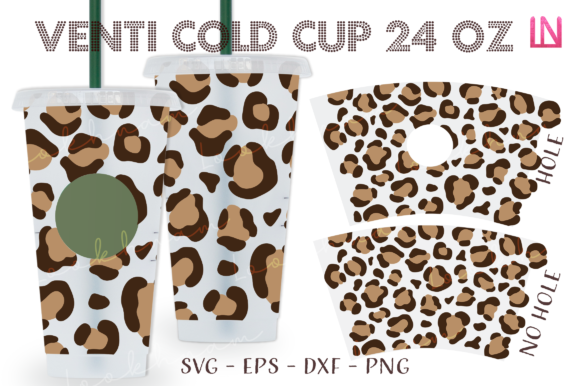
Seamless Leopard 24Oz Venti Cup Wrap SVG
A Designer’s First Glance: Bold, Fluid, and Ready for Real Life
When I opened the Seamless Leopard 24Oz Venti Cup Wrap SVG, my first thought wasn’t “cute” or “trendy”—it was “this has rhythm.” The pattern flows without a hard edge or visible repeat seam, which is rare in leopard motifs that often feel busy or pixelated at scale. As a designer who’s stitched hundreds of animal prints—from subtle watercolor spots to high-contrast graphic roars—I appreciated how this version balances organic movement with clean vector precision. It doesn’t scream; it slinks. That makes it unusually versatile—not just for cup wraps, but for embroidery projects where personality matters without overwhelming the garment or object.
Where It Shines: From Tote Bags to Boutique Merchandise
I tested the Seamless Leopard 24Oz Venti Cup Wrap SVG as a repeating motif on a medium-weight cotton tote bag—no cup, no wrap, just raw fabric and intention. Stitched as a 3.5" wide band across the front, it held up beautifully in satin stitch with a slight gradient thread shift (charcoal-to-cream). Customers at my local craft fair paused longer than usual. One asked, “Is that custom-drawn?” That’s the mark of a strong design asset: it reads as intentional, not clip-art.
It works equally well on sweatshirt cuffs, tea towel hems, and baby onesie back panels—especially when scaled down to 2.25" and simplified to running stitch outlines for delicate fabrics. For Etsy sellers, this is a quiet powerhouse: pair it with neutral apparel, and you’ve got a cohesive, ownable look for a small shop product line. As an embroidered patch? Yes—but only if digitized with open areas to avoid excessive fill stitch density. As a holiday embroidery element on a linen pillow cover? Absolutely. The warmth of the print softens seasonal rigidity without losing edge.
Where to Proceed Thoughtfully
Leopard patterns live or die by their spacing—and this one walks a fine line. On stretchy fabrics like jersey or lightweight knits, the repeat can distort if hooping isn’t precise or stabilizer isn’t layered correctly. I recommend cutaway + tear-away combo for anything over 10% spandex. On dark fabric, test thread contrast first: standard ecru or light gray can disappear unless you boost stitch density slightly or add a subtle underlay.
Curved surfaces—like structured caps or tapered mugs—require careful placement. The seamless nature helps, but don’t assume automatic conformity. You’ll still need to adjust placement manually in your embroidery software to match the curve’s radius. Also, avoid using the full wrap width on tiny hoops (under 4x4"). Crop and repeat intentionally instead of shrinking the entire file—it preserves clarity in the spot detail.
This isn’t a design for ultra-fine applique work or micro-lettering integration. Its strength is in confident repetition, not intricate layering. If you’re planning a monogrammed cup wrap, place the monogram separately—not overlaid—so both elements retain legibility and texture.
What It Adds (and Doesn’t Add) to Your Finished Product
The Seamless Leopard 24Oz Venti Cup Wrap SVG elevates perceived value without demanding premium pricing. It signals craftsmanship—not because it’s technically complex, but because it feels curated. That translates directly to customer trust: buyers recognize when a pattern was chosen, not just dropped in. For handmade product listings, it strengthens brand consistency across categories—same motif on a tote, a tea towel, and a baby bib tells a story.
It doesn’t, however, replace thoughtful execution. A rushed stitch-out on thin fabric will highlight skipped stitches in dense fill areas. And while it’s visually forgiving on most backgrounds, it won’t rescue poor thread tension or mismatched stabilizer choice. Its professionalism comes from how you use it—not from magic built into the file.
Practical Notes Every Embroidery Designer Should Run Through
- Always test on scrap fabric first—especially if stitching on textured weaves like canvas or terry cloth.
- Check thread color contrast across light, mid-tone, and dark fabric swatches before committing to a batch.
- Review stitch density in the tightest cluster zones. If your machine hesitates or threads break, reduce density by 5–8% rather than adding more stabilizer.
- Confirm hoop size compatibility before digitizing for commercial embroidery. This SVG is scalable, but your machine’s maximum hoop area sets the real limit.
- Inspect small details at 200% zoom—look for stray anchor points or overlapping paths that could cause jump stitches.
- Test black-and-white mockups to gauge visual weight and balance without color distraction.
- Compare performance on light vs. dark fabric backgrounds—some leopard tones flatten on black unless underlay is adjusted.
- Use proper stabilizer: medium-weight cutaway for stable wovens, fusible mesh for knits, and water-soluble for sheer layers.
- Verify licensing terms before selling finished items or bundling the SVG into digital embroidery kits—this is a digital download, not a commercial-use blanket license unless explicitly stated.
Final Thought: A Design That Serves the Maker, Not Just the Trend
As someone who reviews dozens of embroidery files each month—many flashy, few functional—the Seamless Leopard 24Oz Venti Cup Wrap SVG stands out for its quiet intelligence. It doesn’t chase virality. It supports intention. Whether you’re an Etsy seller building a signature aesthetic, a craft business owner refreshing seasonal merchandise, or a hobbyist stitching personalized gifts, this is a design that works *with* your process—not against it. It fits naturally into Crafts and Graphics workflows because it respects material reality: fabric grain, thread behavior, hoop limits, and human attention spans. Use it well, and it won’t just wrap a cup—it’ll wrap your brand in something memorable, tactile, and unmistakably yours.