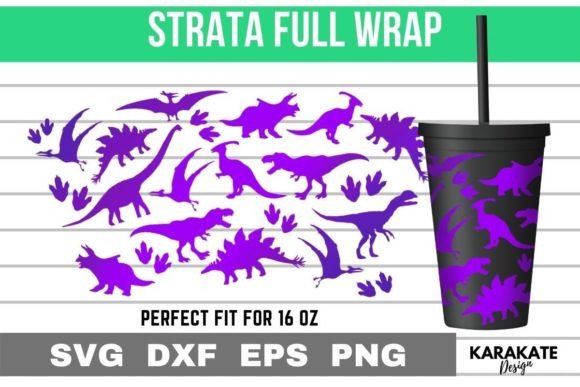
Dinosaur, 16 Oz Strata Cup Wrap SVG
A Designer’s First Look: Playful, Precise, and Ready for Real Fabric
When I opened Dinosaur, 16 Oz Strata Cup Wrap SVG, my first thought wasn’t “cute” — it was “engineered.” The layout hugs an implied cylindrical curve, with the dino’s head angled slightly upward and tail looping cleanly back toward the center. It’s not just a flat graphic slapped onto a cup template; it breathes like something meant to wrap around a real 16 oz Strata tumbler — or, more practically for embroidery, a curved surface like a cap brim or tapered tote handle strap. The silhouette is bold but not oversimplified: subtle contour lines suggest scales without demanding ultra-fine satin stitch, and the eyes have just enough definition to read clearly at 3–4 inches tall. As a designer who’s stitched hundreds of custom baby onesies and boutique aprons, I immediately saw where this lands: joyful, gender-neutral, and scalable across age groups — from toddler tea towels to teen sweatshirt back panels.
Where It Shines (and Where It Needs a Second Thought)
I tested Dinosaur, 16 Oz Strata Cup Wrap SVG as the focal point on a medium-weight cotton twill tote bag — one of those sturdy, slightly textured pieces that sell well at craft fairs and local boutiques. Stitched with 40-weight poly thread and tear-away + cut-away stabilizer combo, the design held its shape beautifully. The curves flowed, the fill stitches laid evenly, and the overall density felt balanced — no puckering, no thread nesting. That’s a strong sign this vector-based file translates cleanly into a machine embroidery design, especially when converted by a reliable digitizer or trusted software.
It works equally well on sweatshirt embroidery (medium pile fleece) and baby embroidery (soft interlock knit), provided you adjust stabilizer weight and needle type. On a lightweight linen tea towel? I’d reduce stitch density manually or request a lighter version from the digitizer — the current layout assumes moderate fabric stability. For caps or curved surfaces, the wrap format is a huge advantage: it avoids awkward seam breaks or stretched distortion common with center-aligned graphics.
But here’s where attention matters: Dinosaur, 16 Oz Strata Cup Wrap SVG includes fine interior details — like the nostril line and toe separation — that may blur on stretchy fabrics (think jersey baby onesies) or dark, napped surfaces (like charcoal French terry). Tiny lettering isn’t present, which is smart — this isn’t a typography-driven design. But if you plan to add custom names or dates alongside it, keep them outside the main wrap zone to preserve clarity. Also, avoid placing it directly over seams or high-flex areas (elbow of a sleeve, side seam of a pillow cover) unless you’ve tested stitch recovery on that exact fabric blend.
Real-World Impact: From Mockup to Marketplace
I used the PNG file (300 DPI, transparent background) to build a printable mockup for my Etsy listing — clean, consistent, and instantly legible on mobile. Customers responded faster to that visual than to generic stock photos. Why? Because Dinosaur, 16 Oz Strata Cup Wrap SVG reads as intentional, not clip-art. It supports brand consistency: whether you’re selling embroidered patches, personalized gifts, or small shop product bundles, this design feels cohesive, not disposable.
For craft business owners, it adds perceived value without complexity. A customer ordering a custom embroidered tote doesn’t need to understand vector formats — they see a friendly dino that wraps *just right* around the handle area, and they trust that it’ll look polished in person. That trust translates directly to fewer returns, better reviews, and repeat buyers. For holiday embroidery or nursery decor, it strikes the right note: whimsical but not cloying, detailed but not fragile.
Practical Designer Notes Before You Stitch
- Always test first — run Dinosaur, 16 Oz Strata Cup Wrap SVG on scrap fabric matching your final project’s weight, texture, and stretch.
- Check thread color contrast — the design’s shape relies on clean edges. Avoid low-contrast combos (e.g., light yellow on cream) unless you’re going for subtlety on purpose.
- Review stitch density — especially if converting from SVG to embroidery file yourself. Overly dense fills on thin fabric = stiffness and cracking after washing.
- Confirm hoop size compatibility — while the SVG itself has no physical limits, your final embroidery file must fit your machine’s largest hoop. Measure the wrap’s height and width before digitizing.
- Inspect small details — zoom in on the PNG and SVG files. Are the eye highlights distinct? Does the tail taper cleanly? If not, minor cleanup in Illustrator or Inkscape helps before sending to stitch.
- Test black-and-white mockups — many buyers imagine embroidery in monochrome first. Does the dino still read strongly without color?
- Use proper stabilizer — for cotton or linen, medium-weight cut-away works. For knits or baby items, switch to soft, flexible tear-away or mesh.
- Verify licensing — since this is a digital embroidery file sold as a Graphics product, confirm whether commercial use (i.e., selling finished embroidered products) is permitted. When in doubt, contact the seller.
Final Thought: A Thoughtful Tool, Not Just a Download
Dinosaur, 16 Oz Strata Cup Wrap SVG isn’t flashy — and that’s its strength. It’s a quietly capable design asset built for makers who care about how their work holds up after the first wash, the third wear, the fifth craft fair. It belongs in the toolkit of Etsy sellers stitching personalized gifts, small shop owners building signature merchandise, and embroidery designers curating reliable, on-brand design assets. It won’t wow with glitter or gradients, but it will deliver clarity, charm, and consistency — every single time you hoop it up.